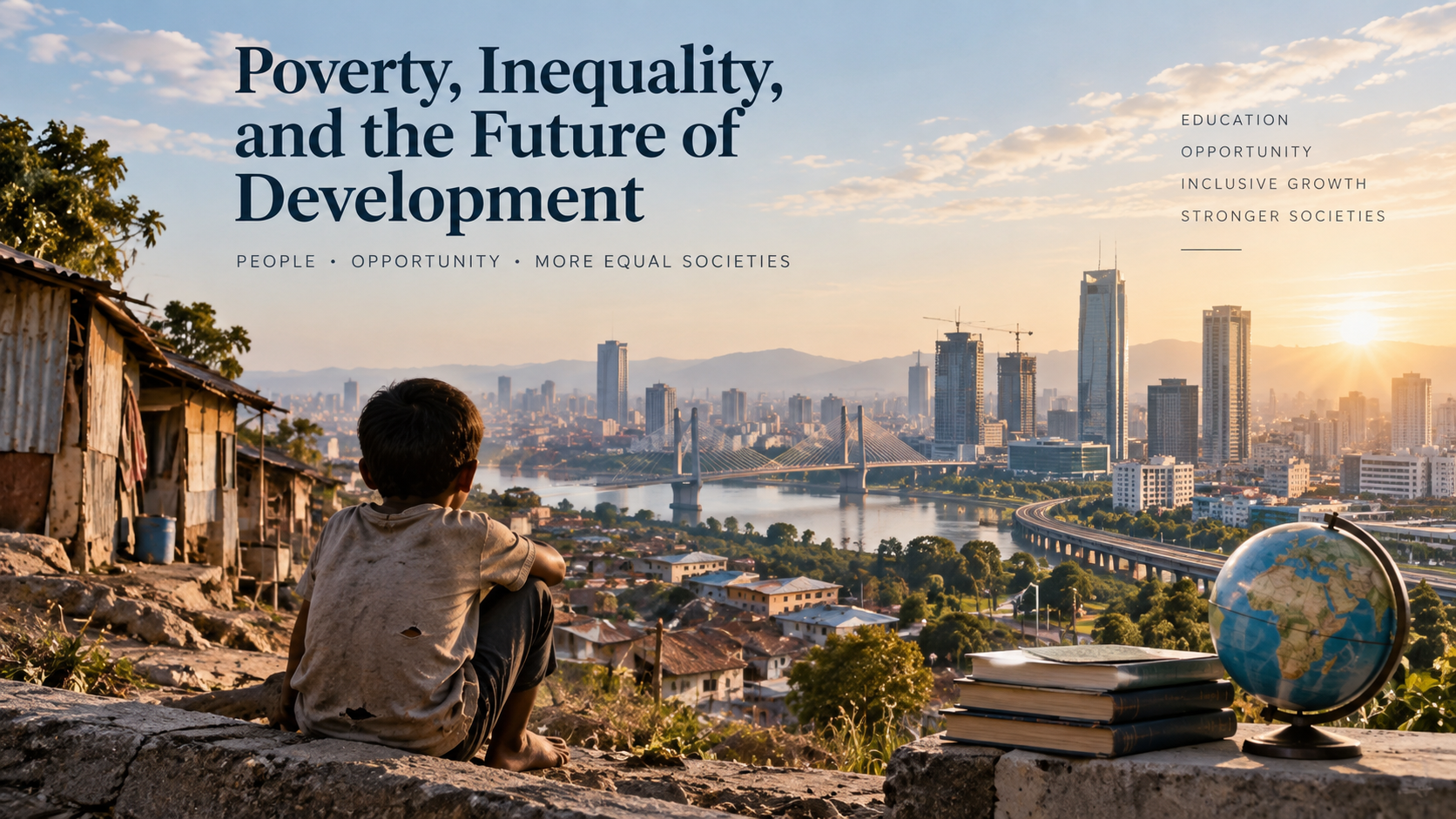
Poverty reduction remains one of the central challenges of development. Economic growth alone does not guarantee broad-based progress; institutions, access to opportunity, education, social protection, and the distribution of resources all shape whether development improves people’s lives. Over recent decades, many countries have achieved substantial economic and social progress. Yet poverty has not disappeared, and inequality remains deeply embedded within and between societies. The central question for the future of development is therefore no longer simply how economies can grow, but how growth can translate into greater opportunity, security, and human well-being.
Growth Is Necessary, but Not Sufficient
Economic growth remains essential to development. Expanding economies can create jobs, increase public revenues, encourage investment, and provide governments with greater resources for infrastructure, education, healthcare, and social protection.
But the distribution of the benefits of growth matters.
An economy may expand while large sections of its population experience little improvement in living standards. When economic opportunities are concentrated geographically, socially, or among particular groups, national growth figures can conceal significant disparities.
This is why development cannot be measured by gross domestic product alone. A more meaningful assessment must also consider whether people have access to productive employment, quality education, healthcare, adequate housing, infrastructure, and realistic opportunities to improve their circumstances.
The challenge is not to choose between growth and redistribution. It is to build economic systems in which growth itself becomes more inclusive.
Inequality Shapes Opportunity
Inequality is not only about differences in income. It also concerns differences in opportunity.
A child’s future may be heavily influenced by where that child is born, the quality of local schools, household income, access to healthcare, digital connectivity, gender, geography, and the economic opportunities available to the family.
These disadvantages can accumulate over time.
Limited access to education may reduce employment opportunities. Low and unstable incomes can make it difficult for households to invest in skills or withstand economic shocks. Poor infrastructure can isolate communities from markets. Weak healthcare systems can turn illness into long-term economic hardship.
As a result, poverty can become intergenerational.
Reducing inequality therefore requires more than transferring income after inequalities have already emerged. Development policy must also expand access to the institutions and services that shape opportunity in the first place.
Education and Human Capital
Few investments are more important to long-term development than education.
Quality education expands individual opportunity while strengthening the productive capacity of an economy. It can increase employment prospects, encourage innovation, improve public health outcomes, and strengthen social mobility.
Yet access alone is insufficient. Children may attend school without acquiring the skills required for a changing economy. The quality of education, teacher capacity, infrastructure, digital access, and the relationship between education systems and labor markets all matter.
Technological change makes this challenge even more urgent.
Automation, artificial intelligence, and the digital transformation of economic activity are likely to alter the skills demanded by employers. Countries that fail to invest in human capital risk creating a widening gap between workers who can participate in emerging sectors and those whose opportunities become increasingly limited.
The future of poverty reduction will therefore depend partly on whether education systems can prepare people not only for today’s labor markets, but for economies that are still being transformed.
Social Protection and Economic Resilience
Poverty is also shaped by vulnerability.
A household may move above the poverty line and then fall back after unemployment, illness, conflict, inflation, a natural disaster, or another economic shock. Development policy must therefore consider not only how people escape poverty, but how they remain out of it.
Well-designed social protection can play an important role.
Income support, unemployment protection, pensions, healthcare coverage, school feeding programs, and targeted assistance can protect vulnerable households while preserving investments in education, nutrition, and health during difficult periods.
The objective should not be permanent dependency. Effective social protection should provide security while helping individuals participate more successfully in economic life.
This becomes particularly important in a world facing greater uncertainty from climate change, geopolitical instability, technological disruption, and demographic pressures.
Institutions Matter
Development outcomes ultimately depend heavily on institutions.
Governments must be capable of collecting revenues, delivering public services, maintaining infrastructure, enforcing rules, managing public resources, and creating an environment in which citizens and businesses can plan for the future.
Weak institutions can undermine even well-designed development strategies. Public spending may fail to reach intended beneficiaries, infrastructure projects may be poorly implemented, and economic opportunities may become concentrated among groups with privileged access to political or financial power.
Strong institutions do not eliminate inequality automatically. But accountable and effective institutions increase the likelihood that public resources are converted into genuine development outcomes.
Governance, therefore, should not be treated as separate from poverty reduction. It is one of its foundations.
Technology: Opportunity and Risk
Technology presents development with an unusual combination of possibilities and risks.
Digital platforms can expand access to financial services, education, healthcare, markets, and government services. New technologies can reduce geographical barriers and allow individuals and small businesses to participate in economic activity that was previously inaccessible.
At the same time, technological change can deepen existing inequalities.
Those with access to capital, connectivity, advanced skills, and high-quality education may capture a disproportionate share of new opportunities. Workers performing routine tasks may face disruption, while communities without reliable digital infrastructure risk falling further behind.
The relevant policy question is therefore not whether technological transformation should occur. Much of it will occur regardless.
The question is whether societies can broaden access to the capabilities required to benefit from it.
Development in a More Fragmented World
The international environment is also changing.
For decades, development strategies benefited from expanding global trade, international investment, technological diffusion, and increasingly integrated supply chains. Today, geopolitical rivalry, trade tensions, conflict, debt pressures, and concerns about economic security are reshaping globalization.
Developing economies may face a more complicated environment in which access to capital, technology, energy, and export markets becomes increasingly influenced by geopolitical considerations.
This makes domestic resilience more important.
Countries will need to strengthen institutions, diversify economies, invest in human capital, improve infrastructure, and build productive capacity while continuing to engage with international markets.
Development policy will increasingly need to balance openness with resilience.
A Broader Definition of Progress
The future of development requires a broader understanding of progress.
Economic growth remains indispensable, but growth should ultimately be judged by what it enables people to achieve. Rising national income means less if large populations remain excluded from education, healthcare, secure employment, infrastructure, or meaningful economic opportunity.
The most successful development strategies are therefore likely to combine several objectives: productive economic growth, investment in human capabilities, stronger institutions, social protection, technological adaptation, and wider access to opportunity.
None of these policies offers a simple solution to poverty or inequality. Development is shaped by history, geography, institutions, demographics, political choices, and the international environment. Different countries will therefore require different combinations of policies.
But one principle is increasingly difficult to ignore.
The durability of development depends not only on how much wealth an economy produces, but on how effectively it expands the capabilities and opportunities of its people.
That may ultimately be the defining development challenge of the decades ahead.